
Believe it or not, none of the images above belongs to a person who ever actually lived. All of this is the product of machine learning and artificial intelligence.
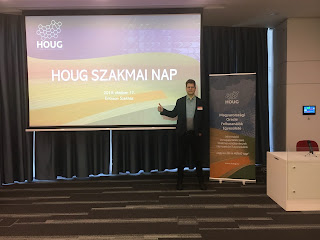
Today, I attended the annual event of the Hungarian Oracle User Group (HOUG), where this topic, among others, came up.
The series of talks started with a presentation from the head of the Klebersberg Center titled "Digitalization in the maintenance of state institutions."
As the father of two school-age children and a strong critic of our education system, I listened with interest to the distribution of 45,630 notebooks (of which 20,000 HP, 8,000 Lenovo, 17,630 Dell) and 24,000 tablets for students plus 800 storage cabinets to teachers and students, the four-level digitalization training for teachers, and the presentation of the modules of the highly successful Kréta system developed by SDA Zrt., but I wasn't convinced.
I'm glad there are attempts being made, but I had the feeling it was like trying to catch up with a speeding train on a skateboard. Still, I'm rooting for it.
From the talk titled "Digitalization in the banking sector," we learned that the mobile phone will become the primary, almost exclusive device we use to access the internet. In this process, trust becomes ever more valuable, since customers will no longer be able to tell whether they are communicating with a real person or a chatbot.
The expected big breakthrough of the coming years will be the collection and processing of vehicle-related data, said the managing director of Inventure Automotive.
We had a good laugh over the "consequences" of a collaboration with a serious waste-collection company, after they fitted their vehicles with this kind of extra data-collection device.
Of course, resourceful drivers, when they went to collect trash somewhere they weren't supposed to, tried to shield the device with aluminum foil.
However, the bin-lifting mechanism still worked, which the system logged, except the vehicle wasn't on the map at the time — and I haven't even mentioned the clever tricks around fueling.
For me, the most astonishing talk was still Balázs Molnár's (Oracle) presentation on "Machine Learning" and "Deep Learning." Although in twenty minutes I didn't manage to fully grasp the relationships between neural networks and the matrices that come out as results, it was clear that the "machine" is able to find the correct result based on the given samples. All of this is simply a function of the number of samples and the available capacity.
So, for example, if we feed in a lot of photos and tell the machine what age and gender the person in the photo is, after a while the machine will know this on its own. What's astonishing is that this also works in reverse. If we ask the machine for an image of a 52-year-old white Canadian woman, the program will draw us one. A picture of someone who never existed.
From the afternoon talks, I'd highlight Ádám Nagy's (K&H bank) talk titled "Cybercrime trends/techniques 2018/2019," where we learned the following very real facts:
Ransomware
- The number of attacks carried out grew by 300% in 2018
- In 2019, on average, someone fell victim to ransomware every 14 seconds
- The number of variants increased by 46%
Mobile phones
- More and more criminal groups are turning toward phones and tablets
- The number of fraudulent programs developed for mobile phones (mobile malware) is continuously growing
- Less than 20% of Android devices are updated, i.e. are vulnerable
IOT (Internet of Things)
- Factory-set home routers can be very easily hacked; changing the password is recommended
- An 800% increase in the number of attacks
- Unnoticeable attacks, careless manufacturers
Finally, phishing has already reached a level where it's almost impossible to tell whether a given email containing a link or attachment is fake.
For example, based on data collected from social media, you get an email from a former high-school classmate (where you went to school) saying that there's an open position at your company (which is your workplace, since it's been advertised) and, given your old acquaintance, could you please forward their (attached, perfectly, precisely and well-worded) CV to HR.
Every email is unique, the topic fits the job, the tone is personal, and the spelling is flawless. In Hungarian. Where have the Nigerian scammers gone.
Once again I got a glimpse into the brave new world, where it is becoming increasingly difficult to distinguish what exists from what does not...